Model cache and storage
Model cache cleanup
Use System → Model cache to inspect disk space and clear downloaded model files after stopping local models. It preserves model definitions, credentials, container images and application data. FreeToken's temporary cache is released with its Pod when the model is stopped. See Scope for the cleanup boundaries.
Administrators open System → Model cache (#/system/model-cache). Each
managed computer reports system-disk capacity/free space and cached model sizes
for Hugging Face/vLLM, Ollama and FreeToken. This is disk space, not RAM or
VRAM. Help is behind information icons. Refresh reads the latest host report;
the host worker samples it on its normal inspection cycle.
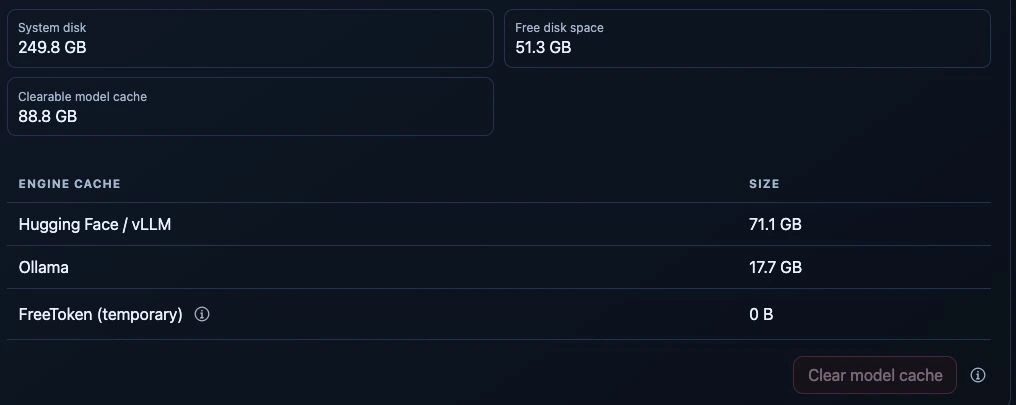
Cropped test-appliance view, captured 24 September 2026. Sizes are examples of disk usage, not RAM or VRAM. Cleanup was not run. When Clear model cache is disabled, use the adjacent information icon to read the blocking reason.
Clear model cache requires the exact computer name in a confirmation dialog. The button is disabled for empty caches, active local models, unavailable/stale workers, Ubuntu maintenance or another host operation. The worker checks live workloads again before deleting anything and before each cache entry. Stop models through Models first; cleanup never stops them automatically. Unpinned model activations and any remaining KubeAI Model resource conservatively protect caches on every node, including scale-to-zero deployments. Existing terminating model Pods must also disappear before cleanup.
Scope
- Hugging Face: only
models--*entries in/root/.cache/huggingface/hub. - Ollama: only
blobsandmanifestsin/root/.ollama/models. - FreeToken: reports its current
runtime-cacheemptyDir. Stop the FreeToken model to release its Pod and temporary cache; this cleanup action never deletes a live Kubernetes volume.
Credentials, other user files, dataset/compiler caches, container images,
application databases and model configuration are not removed. Model files must
be downloaded again on the next start. Sizes are allocated filesystem blocks;
actual free-space recovery can differ with open files, snapshots or hard links.
The system-disk figure describes /; an administrator's custom cache mounts may
use a different filesystem. No storage is formatted or repartitioned.
Execution and deployment
The existing administrator-only POST /api/host-management/operations accepts
action: clear-model-cache, the current cache planId, Node UID/boot ID, a unique
request ID and exact-host confirmation. It accepts no path, shell command or
engine-specific override. The immutable HostOperation uses the existing host
maintenance lock and status flow (Preparing → Succeeded/Failed). Interrupted
deletion is not replayed automatically; refresh and explicitly approve again.
The operator defers new local model runtime reconciliation while any cache cleanup request is pending/active. Stop/removal and external models still work. An enabled model appearing before local deletion causes a safe rejection instead of deleting its shared cache. Arbitrary root/Kubernetes administrators remain trusted; this is not protection from out-of-band host modifications.
The root worker uses fixed directories, descriptor-relative traversal without following parent symlinks, and symlink-resistant deletion. Nested mounts and incomplete or excessively large/slow scans fail closed. Home remains read-only in its systemd sandbox except for the two named cache directories. The API stays unprivileged and receives only a sanitized inventory.
Roll out the host worker/service, HostOperation CRD, controller/RBAC and dashboard API/web together. Old workers show an unavailable message, not a misleading enabled cleanup button. Normal host convergence installs the new helper; opening the page never initiates cleanup or package installation.